R&D Tax Incentive · ITAA 1997 Div 355
Most claims are lost in the record-keeping, not the research.
R&D Tracker is where an Australian company writes its R&D down as it happens — week by week, activity by activity — so that at year end there is a complete, dated, defensible pack to hand to an accountant.
Documentation support, not tax advice. A registered tax agent decides what is actually claimable.
24 of 27
tables with no delete policy
6 fields
checked against the form’s real minimums
10 months
from year end until registration closes
01The cost of getting it wrong
The deadline is the part that cannot be argued with.
Registration closes ten months after the end of your income year — 30 April, for a 30 June year end. There is no late registration and no way to reopen a year that has closed. However good the evidence turns out to be, it arrives too late.
The overseas finding is the one that catches people out. If any of the work was done outside Australia, that application has to be lodged before your income year ends — not with the registration ten months later. That date has never been extendable.
What a reviewer asks for
- 01
The hypothesis you started from, and when you wrote it
Not the outcome. The expectation you held before you knew.
- 02
What you tried, what happened, and what you concluded
Entry by entry, in the order it happened.
- 03
Hours by person by week, against a documented cost basis
Not a percentage of payroll applied after the fact.
- 04
Evidence created at the time
Commits, test results, design reviews, supplier correspondence.
- 05
Which activity each cost belongs to
Registration is assessed per activity, so the costs have to land per activity.
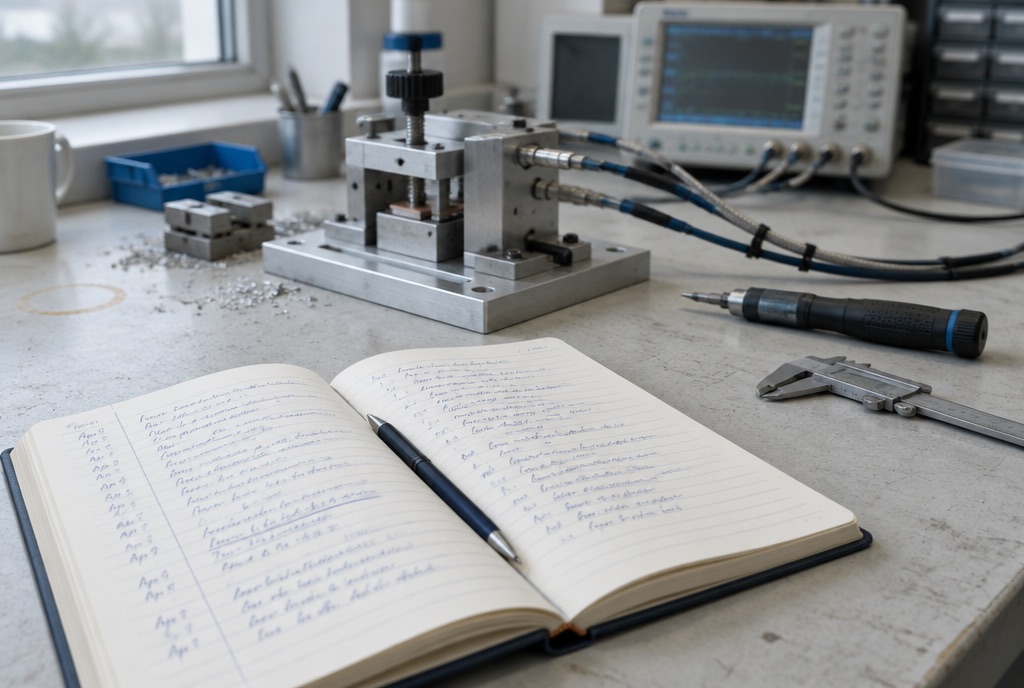
When they do not exist
Nothing happens on the day. The difficulty arrives later, and it is quieter than people expect: a narrative written in April to describe work done the previous September reads like one, and the first question asked is when it was written.
Records assembled afterwards are not a forgery. They are simply weaker — and the weakness is visible to anyone reading them.
The harder question comes first, and it is the one that decided Body by Michael Pty Ltd v Industry Innovation and Science Australia [2025] ARTA 44: whether the outcome could genuinely not have been known in advance. The registration failed because the company could not show that it could not, and that is a question about what was recorded before the work started, not about how the work was described afterwards.
Every one of those five things is small on the day it happens and expensive to reconstruct nine months later. That asymmetry is the entire argument for writing them down weekly, and it is the only thing this product is really for.
02How it works
It works the way a year works.
There is no setup week and no annual scramble. The record is built out of fifty-two small deposits, and every one of them is dated the day it was made.
01
Log the week
Everyone logs their own week: hours against the activity they were actually on, and a line on what was tried. Five minutes, fifty-two times. A week that straddles year end can be broken into days so it lands in the right year.
02
Evidence accumulates
Experiment log entries, files stored with a SHA-256 checksum, expenses and contracts — each attached to an activity, each carrying the date it arrived rather than the date you filed it.
03
Readiness names what is short
Blocking, needed, or a note — per project and per person. Four weeks unlogged. One contractor with no cost basis. A hypothesis 212 characters short of the minimum that the portal will accept.
04
Hand the pack over
One request produces the year: CSVs in the R&D Tax Incentive Schedule’s own categories, the offset working line by line, the evidence index, the amendment trail, and the exceptions.
Readiness, in February
The whole value of a contemporaneous record is that it can still be corrected while the year is open. So the grading is deliberately unflattering, and it is shown early — a green dashboard in April is worth nothing to anyone.
Three levels, used carefully. Blocking means the claim is unsupportable as it stands. Needed means an adviser will ask. Note is context. Marking everything urgent is the same as marking nothing urgent.
03What makes it different
Five things a spreadsheet cannot do.
Every product in this category can hold hours and narratives. These five are properties of how the record is built, which means they are true on the day it is read rather than on the day it was promised.
- 01
Append-only, in the database itself
Not a policy in a manual — a property of the schema. Twenty-four of the twenty-seven tables have no delete policy at all, so there is no code path, ours or yours, that removes a record. Evidence files cannot be overwritten either.
A correction reopens the entry, records who reopened it and why, and appends the new wording beside the old. Nothing is quietly edited, because quietly editing is not available.
- 02
Costs are derived, never typed
Labour comes out of logged hours priced against each person’s own cost basis, with the on-cost method recorded alongside it. Expenses and contracts attach to the activity that consumed them.
There is no field anywhere for a lump-sum estimate of what the R&D cost, and that is deliberate: a figure nobody can trace back to hours is a figure nobody can defend.
- 03
The date a narrative was first written never moves
Each of the six narratives carries its own first-recorded timestamp, written once. Later revisions get their own timestamps and their own reasons; the original date stays where it was, even when the wording around it improves.
That single column is the only honest answer to a question nobody can answer from the text itself: was the hypothesis written before the work it was meant to guide, or afterwards? A date that can be edited is not evidence of anything.
- 04
Activities, not just projects
Registration is assessed per activity, so activities are what the product stores: core activities, the supporting activities that serve them, and the dominant-purpose note where one is required. A project is the container, not the unit of assessment.
The six narrative fields carry the registration form’s real minimum lengths — 600, 650, 650, 530, 340, 600 characters — and the shortfall is shown as you write, rather than discovered at submission.
- 05
R&D effort in person-years, derived
Questions 39 and 40 on the registration form ask for full-time-equivalent person-years. Every competitor asks the customer to estimate them. The hours are already here, and so is each person’s standard working year, so the product computes them instead.
1,940 employee hours against a 1,720-hour year is 1.13 FTE; 450 contractor hours is another 0.26. Both are shown with the hours they came from, and neither is written into your registration until you have looked at it — a derived number nobody checked is worse than an estimate somebody made.
04Year end
The handover is the product.
Everything before this exists so that one request can produce a folder your accountant recognises. Not a PDF of screenshots — CSVs shaped the way the schedule is shaped, plus a plain summary saying what is in each file.
It deliberately includes the things that count against the claim. An adviser would otherwise have to ask for those, and the asking is the slow part.
rd_schedule.csv
Expenditure by project, in the R&D Tax Incentive Schedule’s own categories
activities.csv
The activities and their six narratives — what registration is actually assessed on
offset_working.csv
Every step of the s 355-100 calculation, in order
labour_by_person.csv
Hours and cost per person per project, from the cost basis
experiment_log.csv
The contemporaneous trail, entry by entry
evidence_index.csv
Attached files with SHA-256 checksums
amendments.csv
Every post-lock change, with its reason and timestamp
exceptions.csv
Everything excluded from the totals, and why it was excluded
Or skip the export: invite your accountant into the workspace as an accountant and let them read the live record, exceptions and all. That role is read-only by design and sees the cost figures — the role to give an external adviser.
The offset is the one number everybody wants first, so it is the one most worth showing the working for. Your agent may take a different view on any line of it — which they can only do if they can see the lines.
05Who it is for
Four companies with the same problem.
The record-keeping is identical. What differs is which mistake each one is most likely to make, and the product is opinionated about that.
A software company
AusIndustry publishes a sector guide for software on its own, because ordinary development looks like experimentation from the outside. Weekly logs keep the distinction while it is still fresh: the fortnight spent finding out whether an approach could work at all, against the fortnight spent shipping it.
Work that is excluded outright — the internal admin system, the reproduction of something that already exists — is named as excluded rather than quietly folded in.
A manufacturer
A production run that doubles as an experiment is the hard case, because the same line is turning out saleable product. Hours split R&D and business-as-usual week by week, and a week that straddles year end splits by day.
Expenses attach to the activity that consumed them, and a supporting activity serving a production run carries its dominant-purpose note where the legislation asks for one.
A founder doing this alone
No specialist, no consultant on retainer. The eligibility questions are asked in the words you would use — could someone have looked this up? — with what each one is really testing set out underneath it.
The two facts that end a registration outright, ASIC registration and group structure, are settled when you sign up rather than discovered in April. The rest of the year is fifty-two short entries.
An accountant with several clients
Each company keeps its own workspace and you hold a membership in the ones you work with, so moving between them is one control rather than one login each.
Read the exceptions before the client mentions them. Take the pack as CSVs rather than as a folder of emailed attachments. Overrule any line of the offset working you disagree with — it is shown precisely so you can.
06Assistance
AI is a selector here, not a default.
Every eligibility test and every wording check in this product is a rule, not a model. They run whether or not an API key is configured, and they give the same answer twice — which matters when somebody is about to sign a registration on the strength of them.
That leaves two jobs a model is genuinely better at. Both are optional, and neither is on unless you pick it.
Critique what you wrote
Your own wording, read against s 355-25 and the registration form’s requirements. It names the element of the test your paragraph does not actually address, and the places where it claims more than your evidence supports. It does not rewrite anything.
Draft from your documents
Upload what already exists — design notes, test reports, tickets — and get a first draft with the gaps named rather than filled. The instruction it works to is explicit that padding a short answer to clear a character count is worse than a short answer, because an assessor reads it and finds nothing in it.
And then the record says which. Not a disclaimer at the foot of a page — a stored field, carried into the handover pack, where the person advising you can see it.
07What it does not do
The list a compliance product owes you.
Read this before the feature list. A product that is vague about its edges is asking you to find them yourself, at your own expense.
- 01
It is not tax advice
Nothing here is advice and nothing here decides your claim. R&D Tracker is documentation support: it records what happened, applies the published rules, and shows its working. A registered tax agent decides what is actually claimable.
- 02
It does not lodge anything
It does not submit your registration to AusIndustry and it does not file your company tax return. It gets the material into the shape those forms ask for. You or your agent lodge it.
- 03
It does not invent evidence you do not have
If nobody wrote down what was tried in October, no feature in here can produce it. A gap stays a gap, it is reported as a gap, and it arrives in the handover pack as one.
- 04
It is not an approval, and there is no such thing
Registration under the programme is self-assessed. No product can be approved or endorsed by AusIndustry or the ATO, this one included, and a claim may be examined after registration however well it was documented.
- 05
It will not quietly fix a mistake
Corrections leave a trail, on purpose. Every so often that is inconvenient — and it is the same property that makes the record worth keeping at all.
08Questions
The six that decide whether to bother.
Answered against the legislation and AusIndustry’s own published guidance. Where an answer depends on your circumstances, it says so rather than guessing.
Broadly: a company registered with ASIC, conducting at least one eligible core R&D activity, with at least $20,000 of notional R&D deductions for the income year. The $20,000 floor is relaxed where the work is done by a registered Research Service Provider or under a monetary-contribution arrangement.
Two facts end the matter regardless of how good the research was: a company that is not ASIC-registered cannot claim, and a subsidiary inside a consolidated group does not register in its own right — the head company registers for the group. The product asks both of those before it asks you to write anything, because discovering either at the deadline wastes a year. Your tax agent confirms eligibility; this is not a determination.
Registration closes ten months after the end of your income year — 30 April for a 30 June year end. There is no late registration and no mechanism to reopen a year that has closed.
The one people miss is separate and earlier. If any of the work was done outside Australia, the application for an overseas finding has to be lodged before your income year ends, not with the registration ten months later. That date has never been extendable.
In the terms of s 355-25: experimental work whose outcome could not have been known or determined in advance on the basis of current knowledge, information or experience; determined by applying a systematic progression of work from hypothesis through experiment, observation and evaluation to logical conclusions; and conducted for the purpose of generating new knowledge. All three, for the same activity.
New to your company counts — it does not have to be new to the world. But some activities are excluded outright however experimental they felt: market research, quality control of existing products, reproducing something that already exists, software written for internal administration, and complying with a standard, among others.
Registration is assessed per activity rather than per project, which is why the product models activities and asks the six narrative questions about each one.
They can be written later, and the product will let you: companies routinely find R&D they did not know they were doing. What it will not do is pretend the writing happened earlier. Every narrative carries the date it was first recorded, and an entry logged against an earlier week is marked as backdated.
A reconstructed record with an honest date is worth having. A reconstructed record presented as contemporaneous is the thing that costs claims — and the difference is usually visible to the person reading it.
Because registration is self-assessed, a claim can be examined afterwards: by AusIndustry on whether the activities were eligible, or by the ATO on whether the expenditure was. Both ask for records, and records have to be kept for five years after claiming.
What the product hands over is built for exactly that conversation: the activities and their narratives with first-recorded dates, the hours behind every figure, the evidence index with SHA-256 checksums, the amendment trail, and the exceptions. Having it does not guarantee an outcome. Not having it is the common reason claims are reduced.
Two ways, and most companies use both. Invite them into the workspace as an accountant — a read-only role that sees the cost figures and can change nothing — so they read the live record, exceptions included, themselves. Or take the pack: one request produces a zip of CSVs, shaped in the R&D Tax Incentive Schedule’s own categories, with the offset working line by line, labour by person, the evidence index and the amendment trail, plus a plain-language summary saying what is in each file.
The pack deliberately includes what counts against the claim, because that is what an adviser would otherwise have to ask for — and the asking is the slow, expensive part.
Start where you are
Start with this week.
The first entry is the hardest one and it takes about five minutes. Everything after it is a habit — and at year end, the habit is the claim.
Documentation support, not tax advice. R&D Tracker records what happened and shows its working; a registered tax agent decides what is claimable. Registration under the programme is self-assessed, and no product is approved or endorsed by AusIndustry or the ATO.